Welcome to Datenraum Kultur
Authentic.
Sovereign.
European.
Society's foundations are eroding
Culture is identity, memory and future
Culture provides orientation, dialogue and cohesion. It shapes identity, preserves memory and shapes futures. Yet cultural work has long taken place in both worlds, analogue and digital. New forms of access, mediation and participation are emerging in digital space.
When certainties fade
Are data authentic? Have they been manipulated? Who is responsible for their integrity? Deepfakes, AI-generated hallucinations and strategically distorted information undermine the reliability of digital content. Digital certainty can no longer be taken for granted.
For cultural institutions and cultural practitioners, this is existential. Institutions are regarded as guarantors of authenticity and provenance. Cultural practitioners depend on reliable data for mediation, research and artistic practice.
Trust is becoming a scarce resource. Those who can actively build it and demonstrate it transparently take responsibility.
Sovereignty begins with questions
How do we want to share data in future? According to which rules? For what purposes do we make them available for reuse? And above all: whom do we trust in the process?
These questions are not merely technical; they are fundamental. They decide who controls cultural data, who can benefit from them and which values shape digital spaces.
Without deliberate answers, others will decide.
Cultural institutions are guarantors of authenticity and provenance. In the analogue world, their institutional authority is enough: an object in a museum is genuine because the museum vouches for it.
In digital space, this authority must be extended. Origin needs digital verifiability, not only institutional assertion. Provenance becomes a digital seal of quality. The role remains the same, but it needs new tools.
No longer only: "This picture is valuable and beautiful." But also: "This digital reproduction is authentic, and we can prove it."
Cultural mediation has become more diverse. Apps, installations and digital exhibitions are created collaboratively, between designers, developers and curators. The potential is there. So is the willingness. But between idea and implementation lies infrastructure: data in silos, Excel, PDFs, proprietary systems. Each institution works in its own format. Exchange means export, conversion, duplicate maintenance and lost time.
What could be created collaboratively becomes fragmented. Not because people do not want it, but because the systems do not allow it.
Digital cultural data circulate, and lose their origin along the way. An image moves from archive to presentation to website to social network. At every stop, something is left behind: context, metadata, version information.
What remains is a reproduction without a genealogy. A data set without a history.
Institutions know what belongs to their collections. They have the expertise, the documentation and the knowledge. But in digital space, copies circulate without a route back. Anyone using a digital reproduction gets little help in tracing it back to its origin: the object, the institution, the rights holders.
The credibility gap is not caused by a lack of competence. It arises because origin remains difficult to trace in digital space.
Rights clearance for cultural data takes weeks, often months. Contracts have to be checked, licences clarified and consents obtained. This diligence is necessary and right.
But in digital space, information spreads in minutes, whether true or false.
This is not a question of accuracy versus speed. It is the recognition that as long as legally sound provision remains structurally slow, institutions cannot intervene in digital discourse in time. Others occupy the narrative while clarification is still under way.
Speed becomes a condition for relevance. Not as an end in itself, but because digital space has different temporal dynamics.
Paths.
Connections.
Reality.
Datenraum Kultur
Culture connects us all. We connect culture.
The idea
No central system. No platform power. No data silo.
Instead: a shared space for institutions, cultural practitioners and partners who do not surrender data, but share them. Who are not controlled, but decide for themselves. Who are not at the mercy of others, but act as equals.
Datenraum Kultur is an open infrastructure, a technology that works in the background while people, institutions and shared values remain in the foreground.
What makes it different: mutual consent instead of platform power
Not all cultural data can be open. Law, protection periods and sensitivity must be considered. Centralised platforms come into conflict with sensitive data: those who upload data lose control.
Datenraum Kultur works differently: data sovereignty instead of centralised platforms. Institutions retain full sovereignty over their data. They decide for themselves who receives access and under what conditions. No transfer takes place without a data-use agreement. Trust is built through transparency between contracting parties.
It provides differentiated approvals and clear rules for access and use, grounded in European values: transparency, data protection, fairness.
What sounds like a joke is the central truth about digital infrastructure.
When cultural institutions store their data on central platforms, they reside on someone else's servers, under someone else's terms of business, with someone else's decisions about access, deletion and pricing.
"The cloud" suggests neutrality. But every cloud belongs to someone. And whoever controls the servers controls the data.
Datenraum Kultur works differently: federated and decentralised. Each institution keeps its data on its own servers. The connector brokers access, but the data stay where they belong.
Not "the cloud". Instead: your infrastructure. Your rules. Your sovereignty.
Open data are important, but they are not the solution for all cultural data. Not everything can or may be made openly accessible.
Legal limits: Copyright, protection periods and licences limit what may be published. Many collection objects are legally protected; their digitised versions cannot simply be released.
Sensitive content: Personal data, sacred objects and cultural heritage from Indigenous communities require particular care. The CARE Principles (Collective Benefit, Authority to Control, Responsibility, Ethics) state that certain data may only be used with the consent of the communities concerned.
Protection from misuse: Not all data should be available without restriction, for example data on endangered sites or sensitive research data.
The grey area: Most cultural data lie between "fully open" and "fully closed". Datenraum Kultur enables differentiated approvals, with clear rules for access and use depending on context and purpose.
Not all or nothing. Instead: controlled, transparent and traceable data use.
Many digital infrastructures follow a centralised model: everyone uploads their data to a shared platform. One place, one system, seemingly simple.
But anyone who uploads data gives up control. The platform defines the terms of business. It decides on access, storage and deletion. It can change prices, restrict functions or discontinue the service.
For sensitive cultural data, this is problematic. Institutions lose sovereignty over their own holdings. They become dependent on providers whose interests do not necessarily align with the needs of the cultural sector.
Data sovereignty means: Retaining self-determination over one's own data. Being able to decide who receives access and under what conditions. Not being at the mercy of platform logic.
Datenraum Kultur enables exchange without loss of control. Federated instead of centralised. Self-determined instead of dependent.
How the secure space is created
Datenraum Kultur is a shared, federated infrastructure for cultural data. Institutions exchange data without giving them away. Each institution keeps its data with itself, in its own databases and on its own servers.
The Datenraum connector brokers access according to the rules set by data providers. It works like a smart safe with a lawyer built in: you define the conditions under which the safe may be opened, what may be done with the data, and every access is logged. The connector negotiates between the contracting parties: bilaterally, transparently and traceably.
The data remain with you. But exchange becomes possible in a secure, controlled and technically protected way.
What exchange makes possible
Legally sound data use without manual effort. New opportunities for cooperation: between museums and design studios, archives and publishers, researchers and artists, institutions and the creative industries.
Especially in the age of AI, transparent and traceable data use is essential so that cultural institutions and cultural practitioners can help determine how their data are used, rather than watching them flow uncontrolled into training data sets.
Where exchange takes place, trust emerges. Where trust grows, new forms of cooperation become possible. Datenraum Kultur provides the infrastructure for this: not as an end in itself, but as a tool for cultural work in digital space.
How it works
Technical foundation: the EDC connector
Data spaces are a well-developed, internationally accepted concept standardised by the International Data Space Association (IDSA). Datenraum Kultur uses open-source technology, specifically the Eclipse Dataspace Components (EDC). This is not a proprietary solution, but an open standard developed by a broad community on GitHub.
The architecture is federated: each institution operates its own connector and keeps its data on its own servers. There is no central data store; only authentication and the metadata catalogue are centralised.
These components create trust and are ideally operated jointly by the participants: a network of equal partners on equal footing.
Key components of the connector
The EDC connector works with four basic elements according to the standards set by International Data Spaces (IDSA):
Assets - the description of the actual data to be shared.
Access Policies - access rules that define who may find the offers.
Contract Policies - usage requirements that define how the data may be used.
Contract Definitions - the binding offer that is ultimately negotiated between the partners.
Every data transfer is based on a contract. No access without agreement.
Datenraum Kultur is based on proven open-source technology. But how does exchange work in concrete terms, in an institution's everyday practice?
How data are shared
Data are never stored centrally. They remain on the institution's own servers, in its own databases. The connector only brokers access, according to the rules defined by the institution.
Every access is based on a negotiated contract. Use is technically protected. Changes to data sets can be transferred as versions, so everyone involved stays up to date.
Exchange without loss of control.
The Datenraum Kultur connector is based on Eclipse Dataspace Components (EDC) - an open-source technology for sovereign data exchange. The architecture is federated: each institution operates its own connector and keeps its data on its own servers. There is no central data store.
The XFSC catalogue is the search directory for Datenraum Kultur: it lists which data are offered by whom, so interested parties can find and request them without the data themselves being disclosed.
Key components
Assets - the actual data (images, metadata, texts, audiovisual material).
Policies - rules for access (Access Policies) and use (Contract Policies), defined in ODRL (Open Digital Rights Language).
Contract Definitions - binding offers that link assets with policies as the basis for Contract Offers then published in the catalogue.
Catalogue - federated overview of available data offers.
Contract Negotiation - negotiation process between provider (data provider) and consumer (data recipient).
Contract Agreement - final, technically protected agreement.
Transfer Process - data transfer according to agreed rules.
The process
- Provider creates asset and defines policies
- Provider creates Contract Definition
- Consumer discovers offer in the catalogue
- Consumer initiates Contract Negotiation
- Both parties reach a Contract Agreement
- Consumer initiates Transfer Process
Data flow bilaterally under the agreed conditions
Transfer mechanisms
EDC supports two transfer patterns:
PULL transfer - the consumer pulls data from the provider. After a successful Contract Agreement, the consumer receives an Endpoint Data Reference (EDR), a temporary, authenticated access route to the provider's Data Plane. The consumer can then access the data directly for as long as the agreement is valid.
PUSH transfer - the provider pushes data to the consumer. In the transfer request, the consumer specifies a target URL (Data Sink). The provider transfers the data there once the agreement is in place.
Both patterns are technically protected. Every access is logged. Policies are enforced at transport level.
Integration into existing systems
The EDC connector separates the Control Plane (negotiation, contracts, policies) from the Data Plane (the actual data transfer).
Backend connection: assets can be defined either as static files or as API endpoints. For database connections, you implement a Data Source Adapter that encapsulates queries to your internal systems. The connector handles authentication, policy enforcement and contract logic; your backend systems remain protected behind it.
Standards: EDC implements the Dataspace Protocol (formerly IDS Protocol), uses DCAT for asset descriptions, ODRL for policies and JSON-LD as the data format. This guarantees interoperability: any standards-compliant connector can communicate with any other, regardless of vendor.
API integration
The EDC connector provides a management API for asset management, policy definition, contract negotiation, transfer processes and catalogue queries. Authentication takes place via API key in the X-Api-Key header. The sovity EDC UI API Wrapper simplifies integration with typed interfaces and simplified state models.
Connector operation
The connector is provided as a managed service (Docker/Kubernetes based) or can be self-operated in your own infrastructure. Cloud deployment and on-premise operation are both possible. Full technical documentation, API reference, implementation examples and OpenAPI specification:
How does data exchange work in concrete terms?
Datenraum Kultur works with two roles: data provider (Provider) and data recipient (consumer). Both follow structured workflows that are technically protected by the EDC connector.
Data-provider workflow
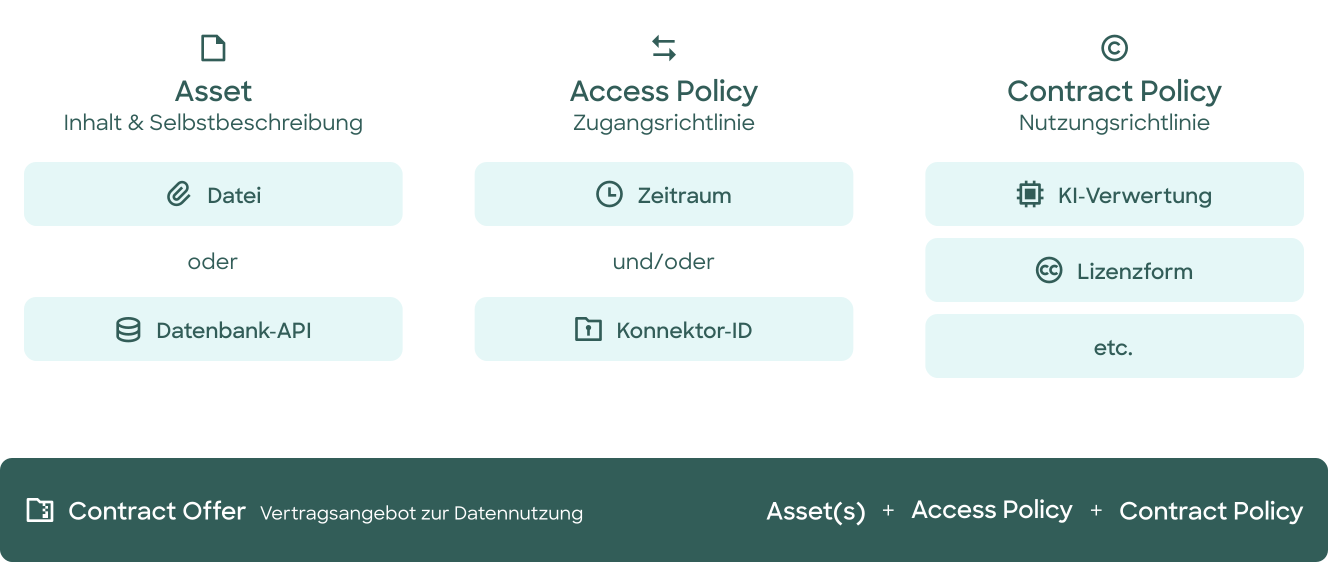
As a data provider, you create a data offer (Contract Offer) consisting of three components:
- Asset - a self-description with metadata for display in the catalogue, describing the actual content: this can be a file, a collection or API access to your database
- Access Policy - who may access it? You define access rules, such as time limits (e.g. for one year only) or access authorisation only for specific connectors (via connector ID). Combinations are possible.
- Contract Policy - how may the data be used? You define usage rules: is AI training permitted? Which licence form applies (CC-BY, CC0, proprietary)? Are there further restrictions? These are defined in machine-readable ODRL format.
Together, these three elements form your Contract Offer - a binding, machine-readable offer in the data space.
Data-recipient workflow
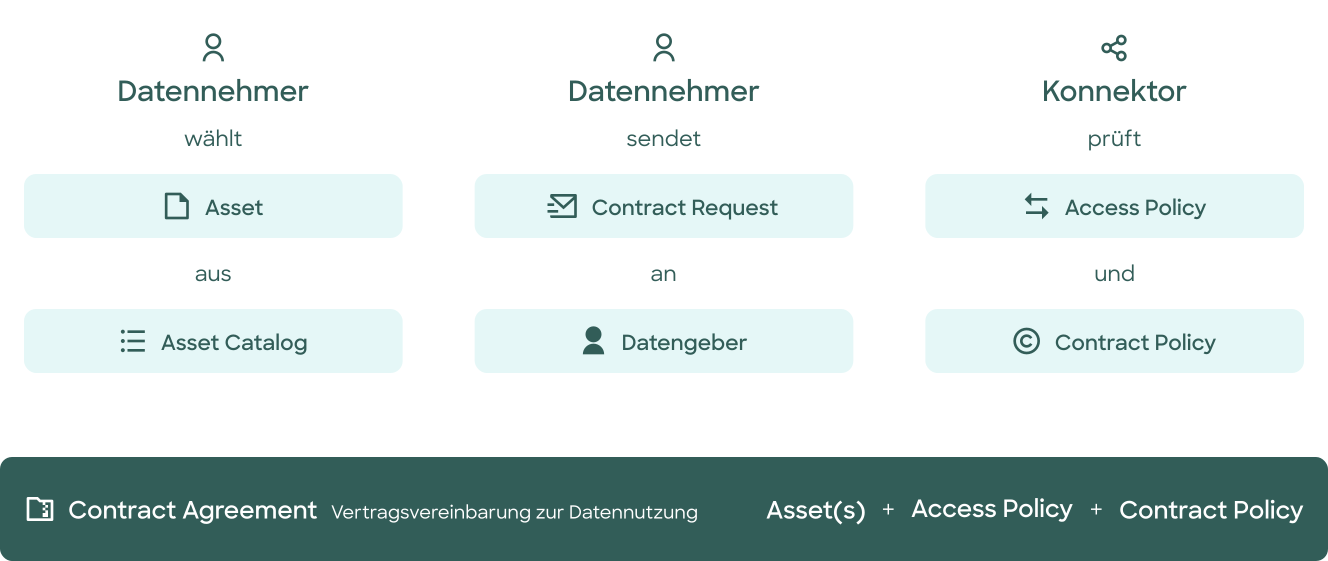
As a data recipient, you go through three steps:
- Select - you discover interesting data offers in the Asset Catalogue, which lists all available offers in the data space in a federated way. You see which data are available and under what conditions.
- Request - you send a Contract Request to the data provider. This request contains your consent to the terms of use.
- Check - the data provider's connector automatically checks whether you meet the Access Policy (e.g. authorised institution, correct time period) and whether you have accepted the Contract Policy.
When all conditions are met, a Contract Agreement is created: the legally and technically protected data-use contract that is automatically stored in the two participating connectors.
Important: Data only leave the data provider's server after the Contract Agreement has been concluded. The requesting connector initiates the transfer and the providing connector only then allows access to the data. You retain full control at all times over who receives what and under which conditions.
Connector operation and user interface
The EDC connector is designed for self-operation on self-managed infrastructure. If no infrastructure of your own is available, the connector can be provided by the data-space operator as a managed service, including technical support, updates and maintenance.
The connector provides a web-based user interface with:
Secure authentication - two-factor authentication (2FA) protects access.
User management - roles and permissions can be managed for the organisation itself.
Workflow support - the GUI guides users through the entire process: from asset creation and policy definition to contract negotiation and data transfer.
This means users without deep technical knowledge can also operate the data space.
What an institution needs
Its own data holdings - not only metadata, but the data themselves: digital reproductions of collection objects, research data, text corpora, audiovisual material. Whatever is to be shared must be structured and accessible.
Technical access - through an institution's own connector or via a service provider.
Usage rules - clear definitions of who may access the data and under what conditions.
And, of course, a willingness to make valuable data available. Nothing more is needed.
What institutions gain
Less manual effort - no more duplicate maintenance in which the same data must be maintained in parallel in different systems. Updates are synchronised automatically.
Legally sound data use - through clear contracts and technically protected usage rules. No more grey area around licensing questions.
New opportunities for cooperation - between institutions, with the creative industries, with research and education. Exchange becomes simpler.
Reliable basis for AI, research and mediation - quality-assured, traceable data for new applications.
Datenraum Kultur makes possible what previously failed for lack of infrastructure.
Use cases
Four pilot projects have tested Datenraum Kultur. They show how the technology works in different cultural contexts: museums connect their collections, theatres share production data, and music practitioners collaborate across institutional boundaries.
These use cases are proof that Datenraum Kultur works. And it is scalable: for a Germany-wide and Europe-wide ecosystem of sovereign data exchange.
How can cultural and event data be shared across platforms without cultural practitioners losing control? The "Connected cultural platforms" use case examined and prototyped how open cultural data can be aggregated, connected and mediated in a user-oriented way, while preserving full data sovereignty. At the same time, reach, findability and reusability were to be improved.

What was implemented
Existing regional cultural platforms such as OWL live and kulturis were connected with one another as prototypes. For this, a flexible data-exchange format was created that enables event, location and person data to be harmonised and transferred between different platforms.
Building on this, AI-supported recommendation services were tested: content-based, without central tracking, and based on semantic event data.
In cooperation with the German Digital Library (DDB), event data were automatically enriched with cultural context information, such as background information on artists, works or historical references.
In parallel, user stories and customer-journey models and a domain-specific modelling language were created to systematically map user and stakeholder needs on cultural platforms.
Another focus: business-model analysis for cultural platforms, including market and cluster analysis as well as partial validation of the "sponsoring" model.
Benefits and added value
Connecting cultural platforms in Datenraum Kultur is technically feasible and creates concrete added value:
For cultural actors - reduced editorial effort and greater visibility for their offers beyond regional boundaries.
For people interested in culture - easier discovery of relevant events, better recommendations and enriched contextual information.
For platform operators - new data-based added-value services and robust business models for sustainable operation beyond project-based funding.
The use case shows that cultural platforms can work in a connected way without giving up their independence.
The concepts developed in Datenraum Kultur are based on academic research and have been documented in several white papers and peer-reviewed publications. Paderborn University played a central role through the Software Innovation Campus Paderborn (SICP).

To mark the 250th birthday of Caspar David Friedrich, the web portal cdfriedrich.de brings together the works of the best-known painter of German Romanticism in a collaboration between Hamburger Kunsthalle, the Alte Nationalgalerie of the Staatliche Museen zu Berlin and the Staatliche Kunstsammlungen Dresden.

To bring Friedrich's art closer, the portal offers various multimedia content and formats, showing the potential of connected collection data: images, metadata, audio and video files, and work texts from different sources provide a broad overview in the chronology.
Shortcuts concisely open up Friedrich's themes from today's perspective, and the Digital Stories allow users to explore individual works in depth. A 360-degree tour combines the data into a digital spatial experience and tests ticketing for digital content. The web portal is continuously developed and complements the exhibitions in Hamburg, Berlin and Dresden.

A theatre maintains its programme. Suddenly it appears on twenty platforms. Automatically. Without additional effort.
This is not the future. It works now.
The problem
Every theatre has a programme. But every theatre maintains it differently. Different systems, different formats, different structures. Anyone who wants to aggregate theatre data, such as event platforms, ticket agencies or archives, has to do manual follow-up work: copy, adapt, update.
That costs time. And small theatres without large PR departments? They remain invisible.
The solution
A standard for machine-readable theatre programmes. ORIF is an open, licence-free interface. Implement it once, set it up once. After that: automatic data exchange. Theatres, platforms, ticket agencies and archives all speak the same language.
Technically: JSON format. Easy integration into existing systems. Seamless connection to APIs and the Datenraum Kultur infrastructure. Extensive documentation with code, so web agencies or in-house IT departments can implement it smoothly.
What this means
Greater reach: programmes appear on a wide range of platforms. Automatically updated. Without manual effort. Greater visibility for small theatres: even venues with limited PR capacity reach their audiences. The standard creates equality. Academic standards in cultural operations: scheduling and performance data become structured, comparable and usable over the long term. For research, for archives, for cultural analysis.
Smart theatre services show that digital bridges are not created by central platforms, but by open standards that anyone can use.

You are looking for piano lessons. Tuesdays, 6 pm, near you. For advanced learners. In three clicks, you have five suitable teachers, with profile, availability and contact details.
This is musiq.me - a data-based matching tool that automatically brings together supply and demand in music education.

The problem
Finding music lessons is laborious. Searchers trawl websites, directories and social media. Music schools maintain data in their own systems. There is no central overview, and even if there were, it would be unclear: who has time? Who teaches online? Who is still accepting students?
The solution
musiq.me captures relevant criteria in a structured way: postcode, instrument, age group, experience level, availability and teaching format. Searchers do not receive lists, but matching teacher profiles. Concrete, individual and immediately usable.
The data come via the Datenraum infrastructure. Music schools and teachers retain full sovereignty over their data. musiq.me is an intermediary application layer, not a central data silo.
More than matching
The nkoda app is integrated, making digital teaching material immediately accessible. The Sirius space provides infrastructure for online trial lessons. Matching, material and the start of lessons are connected without breaks.
What this means
For searchers - faster, more targeted access to music lessons.
For teachers and music schools - higher visibility, automatic matching and full data control.
For the ecosystem - matching without a data monopoly.
Smart music services show that matching does not need centralisation. It needs standards, sovereignty and intelligent mediation.

Practical example: Caspar David Friedrich Portal
The web portal cdfriedrich.de is the proof: Datenraum Kultur works. Not in theory. In practice.
The problem
Three museums. Three collection systems. Three data formats. Hamburger Kunsthalle, Staatliche Kunstsammlungen Dresden and Staatliche Museen zu Berlin all hold important works by Caspar David Friedrich. But their IT systems do not speak the same language.
The question was: how do we mediate together, without technical standardisation, without a central platform and without loss of sovereignty?
The answer
The portal exemplifies what becomes possible through sovereign data exchange between museum collections: a comprehensive understanding of Friedrich's work and his time, across collections and media, accessible to a broad audience.
The EDC connector technology makes this possible: data from different collections are connected according to the rules of the data providers. Each institution retains control over access and use.
High-quality digital assets were created: audio, video and art-technological recordings. Newly contextualised, newly mediated.
132,000 people have seen it. A game was developed from it. Three museums share their data without constant manual maintenance.
Why the CDF portal matters
Proof of practical viability: more than 132,000 visitors, broad media response and successful reuse by the creative industries (game nomination for the TOMMI Award). Datenraum Kultur works in real operation.
Even low levels of digitisation are no obstacle: different collection systems, varying data quality; the portal shows that connection is nevertheless possible.
Technology supports content, not the other way round: EDC technology remains in the background. Cultural mediation is in the foreground: sovereign, cooperative and without loss of control.
Next steps
More participating institutions
Four use cases have tested the technology. But its potential only unfolds as the network grows.
More museums, more archives, more libraries. Theatres, music schools, cultural centres. Research institutions, creative industries, educational institutions. The more institutions participate, the more valuable the data space becomes for everyone.
What is special: Different collection and IT systems are no obstacle. Different data formats and ontologies can be connected. Central data storage is neither necessary nor wanted.
Datenraum Kultur is open to everyone seeking sovereign data sharing. The next phase means: Invite, activate, connect.
Expansion to media and AI applications
The use cases have shown what is possible with metadata, images and event data. But Datenraum Kultur can do more.
Audiovisual media: Films, sound recordings, oral-history archives: large volumes of data that have previously been difficult to share. The data space enables exchange even with high data volumes, with controlled access rights.
AI applications: Training, quality assurance, transparent use. Cultural institutions and cultural practitioners can help determine how their data are used, rather than watching them disappear uncontrolled into training data sets. The data space provides the infrastructure for this.
New forms of mediation: Immersive experiences, personalised recommendations, barrier-free access. Data from different sources can be combined, enriched and recontextualised.
The next phase means opening up new fields of application, developing innovative services and making added value visible.
Automated updates and sustainable operation
The use cases were funded as projects. But digital infrastructure needs continuity.
Automated updates are the key: no more manual duplicate maintenance. Data are maintained once and synchronised automatically. This saves time, reduces errors and keeps information up to date.
The CDF portal has proven that even low levels of digitisation are no obstacle. The technology adapts, not the other way round. It supports content rather than dominating it.
But after the project ends, this requires sustainable operating models: Who carries the infrastructure? Who develops it further? How will the data space be financed in the long term?
The next phase means moving from funding to regular structures, from project to ecosystem.
it works.
Let us develop it further together.
Datenraum Kultur is not a finished product. It is a living infrastructure, which grows as institutions use, extend and shape it.